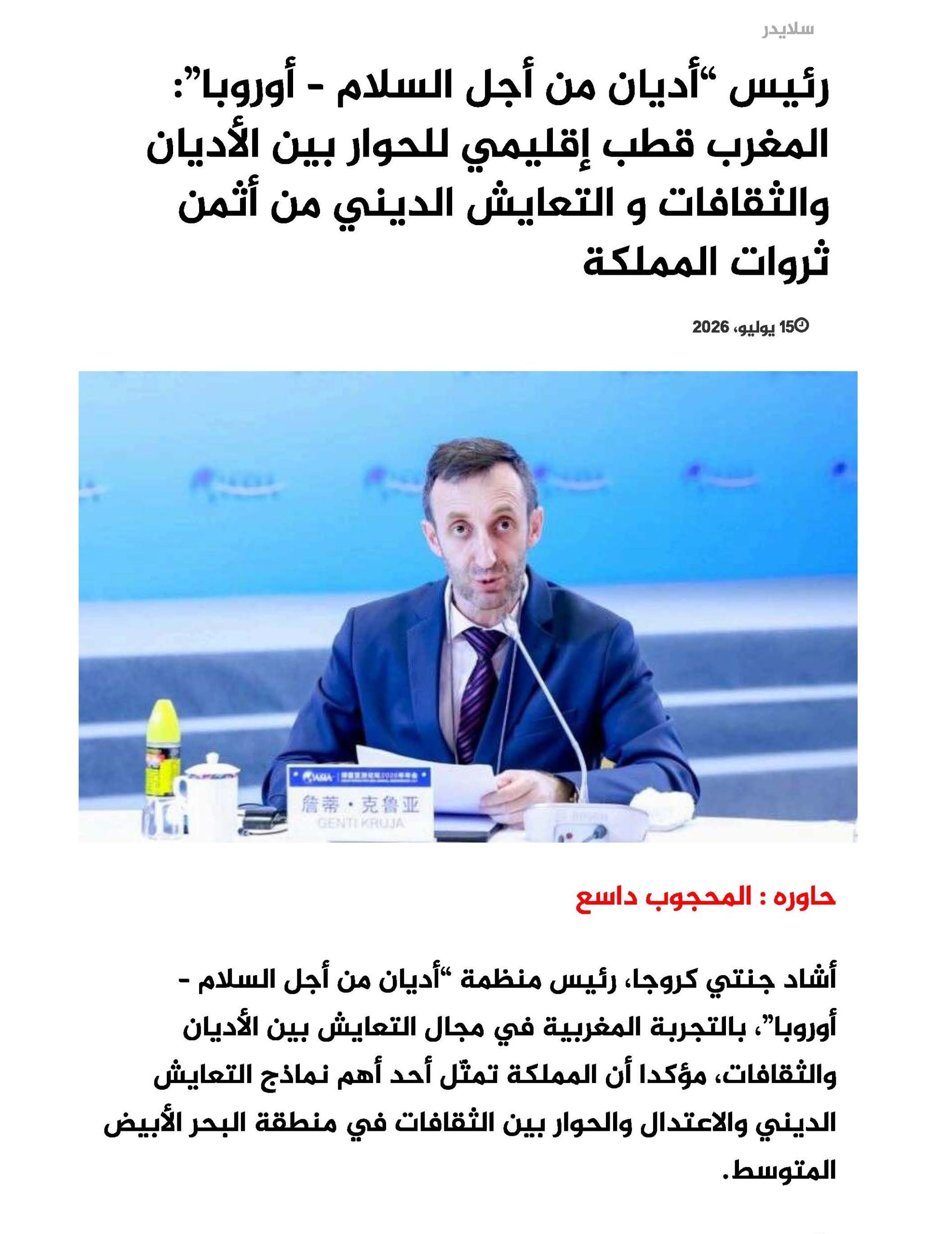
In an Interview with the Moroccan Newspaper Aldar.ma, RfP Europe President Prof. Genti Kruja Highlights Shared Sacred Flourishing and Morocco’s Role in Interreligious Cooperation
15 July 2026
Prof. Genti Kruja, President of Religions for Peace Europe, has highlighted the growing role of interreligious cooperation in responding to conflict, social polarization, technological change, and other challenges facing societies today.
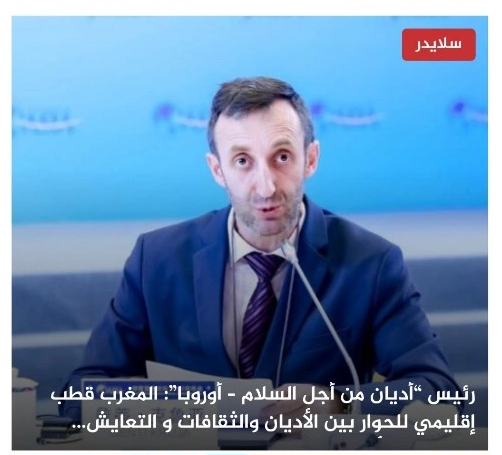
In an extensive interview with the Moroccan national news platform Aldar.ma, conducted by journalist El Mahjoub Dassa, Prof. Kruja presented the work and strategic vision of Religions for Peace Europe. He emphasized that interreligious dialogue must move beyond discussion and become a transformative force capable of building trust, restoring damaged relationships, and mobilizing communities for concrete joint action.
“Dialogue is not an end in itself, but the starting point for tangible cooperation for peace, justice, and human dignity,” Prof. Kruja stated.
A central focus of the interview was the vision of Shared Sacred Flourishing, which is increasingly guiding the work of Religions for Peace. Prof. Kruja explained that this approach encourages religious and cultural communities to recognize their shared responsibility to protect life, promote the common good, and care for future generations.
Shared Sacred Flourishing does not seek to merge religious traditions or create a new religious identity. Rather, it respects the distinct identity of each tradition while providing a common space for cooperation founded on values such as compassion, justice, tolerance, solidarity, and human dignity.
Prof. Kruja also outlined the broader priorities of Religions for Peace Europe, including the promotion of peaceful, just, and inclusive societies; the empowerment of women as peacebuilders; the engagement of young people; the protection of freedom of religion or belief; environmental responsibility; and the strengthening of pluralistic societies.
He underlined the importance of RfP Europe’s network of national interreligious bodies, religious leaders, women of faith, and interfaith youth, describing it as an essential infrastructure for dialogue and cooperation across the continent.
Religious Leadership in the Digital Age
The interview also addressed the responsibilities of religious leaders in an increasingly digital world. Prof. Kruja noted that artificial intelligence, social media, and digital technologies are transforming how people access information, shape their identities, and relate to one another.
Religious leaders, he argued, must therefore develop greater competence in public communication, media literacy, digital ethics, and the ethical use of emerging technologies, while preserving the irreplaceable human qualities of empathy, wisdom, listening, and compassion.
He also called for stronger cooperation between religious communities, journalists, academics, technology experts, and public institutions to address online extremism, misinformation, and hate speech.
Rather than merely responding to harmful narratives, Prof. Kruja stressed the need to build credible alternative narratives based on truth, hope, human dignity, and shared responsibility. He identified peace journalism and responsible sacred storytelling as important tools for rebuilding trust and promoting mutual understanding.
“We can transform faith into action, dialogue into cooperation, and diversity into a source of strength for peace, justice, and sustainable development.”
The full interview was published in Arabic by Aldar.ma on 15 July 2026.
 Below you can find the full interview in English:
The world is witnessing an unprecedented rise in armed conflicts, political polarization, and social fragmentation. In your view, what role can interfaith and intercultural dialogue play in addressing these global challenges?
I believe we are living through one of the most complex periods in modern history. The wars and conflict in Ukraine and the Middle East, geopolitical tensions, migration, climate change, economic inequalities, extremism, political polarization, and technological revolutions are not separate crises, but parts of a shared reality that is challenging the foundations of human coexistence.
In this context, interfaith and intercultural dialogue can no longer remain merely a diplomatic instrument or a forum for discussion. It must become a transformative force that builds trust, restores damaged relationships, and mobilizes communities for joint action.
At Religions for Peace Europe, we strongly believe that the time has come to move from dialogue to action. This is also the philosophy I presented in my presidential report: dialogue is not an end in itself; it is the starting point for concrete cooperation for peace, justice, and human dignity.
Today, we are developing a new vision, Shared Sacred Flourishing, which invites us to look beyond our religious and cultural differences and recognize that all religious traditions share a common responsibility to protect life, strengthen the common good, and care for future generations. This vision does not seek to homogenize religions or create a new religious identity; rather, it respects the identity of each tradition and creates a space in which they can cooperate on the basis of universal values such as compassion, justice, mercy, forgiveness, and solidarity.
Peace is not built only at diplomatic tables. It is built in schools, universities, the media, religious institutions, families, and local communities. That is where trust is born. And that is where sustainable peace begins.
What are the main priorities of Religions for Peace Europe in promoting peace, dialogue, and social cohesion across Europe and beyond?
In recent years, Religions for Peace Europe has undergone an important process of institutional and strategic consolidation. Following the adoption of the new Statute and new regulations, our organization has become stronger, more sustainable, and more active at both European and international levels.
Today, our work is guided by the six global strategic priorities of Religions for Peace.
The first priority is building peaceful, just, and inclusive societies. We believe that religious communities possess a unique moral authority to prevent conflict, counter extremism, and promote reconciliation.
The second priority is empowering women as leaders for peace. Through the Women of Faith Network and initiatives such as “Mothers for Peace,” women are taking an increasingly important role in mediation, education, and trust-building.
Another priority is our commitment to environmental protection and climate justice. Climate change is not only an ecological crisis; it is also a moral and spiritual challenge that calls for shared responsibility.
Equally important is the protection of freedom of religion or belief, human dignity, and the promotion of pluralistic societies.
We have also strengthened our network of 12 European National Interreligious Councils, the European Council of Religious Leaders, the Women of Faith Network, and the European Interfaith Youth Network, which together constitute an important infrastructure for dialogue and cooperation across Europe.
A new dimension of our work is Shared Sacred Flourishing itself. This is not merely a theoretical concept, but a concrete working methodology. It helps us identify not only the symptoms of conflict, but also their deeper causes; analyze the spiritual and social assets of our communities; and jointly develop solutions that serve the common good. Action that is not grounded in a shared moral vision risks being reactive, fragmented, and short-term. By contrast, action based on a shared understanding of the sacred becomes transformative and creates shared responsibility.
For this reason, our vision is to transform faith into responsibility, dialogue into cooperation, and diversity into a source of strength for peace.
How should religious leadership evolve in response to rapid technological and societal transformations?
Religious leadership cannot remain confined to models of the past. It must remain faithful to tradition while engaging in continuous dialogue with the new realities of our time.
Today, artificial intelligence, social media, and digital technologies are changing how people access information, shape their identities, and build relationships. The younger generation lives in a communication environment entirely different from that of just a decade ago.
Religious leaders must therefore develop new competencies in public communication, technology ethics, media literacy, and digital culture. They need to be present where people are, especially young people.
At the same time, technology cannot replace the human dimension of leadership. No algorithm can replace compassion, attentive listening, forgiveness, wisdom, and care for others.
The concept of Shared Sacred Flourishing reminds us that the human person is, fundamentally, a relational being. We do not live in isolation, but in relationship with God, with one another, with society, and with nature. Religious leadership must therefore be leadership that builds relationships, cultivates virtues, and strengthens institutions that serve the common good. Only in this way can we navigate technological transformations without losing our humanity.
Ultimately, the leadership of the future will not be measured by formal authority, but by the ability to inspire hope, build trust, and unite people around a shared vision for peace.
What responsibilities do religious leaders have in combating online extremism, misinformation, and digital hate speech?
In the twenty-first century, the digital sphere has become one of the main battlegrounds in which opinions, identities, and social relationships are formed. Unfortunately, it has also become an environment in which disinformation, conspiracy theories, hate speech, and extremist narratives spread rapidly.
For this reason, the responsibility of religious leaders can no longer be limited to places of worship. We have a moral duty to be present in the digital space as well, offering credible, moderate, and truth-based voices.
At Religions for Peace Europe, we believe that it is not enough merely to react to hatred; we must build alternative narratives that promote respect, human dignity, and solidarity. Shared Sacred Flourishing teaches us that conflict does not arise only from differences, but also from broken relationships. Addressing hate speech must therefore begin with rebuilding trust and a culture of dialogue.
Religious leaders must work closely with journalists, academics, technology experts, and public institutions to strengthen media literacy, digital ethics, and society’s resilience against manipulation. We cannot fight hatred through prohibitions alone; we must replace it with hope, truth, and shared responsibility.
How can we strengthen the capacities of journalists, digital content creators, influencers, and communication professionals to produce balanced, moderate, and peace-oriented media content that promotes tolerance, coexistence, and mutual understanding while rejecting violence, extremism, and hatred?
The media and public communication have an extraordinary influence on how societies perceive religion, diversity, and the “other.” Journalists are therefore not only reporters of events; they also shape public culture.
I believe it is time to invest in what we may call Peace Journalism. This does not mean concealing problems or conflicts, but reporting on them with professionalism, responsibility, and human sensitivity. Alongside reporting crises, the media should also tell stories of cooperation, solidarity, and reconciliation.
In this regard, the concept of Sacred Storytelling, promoted through the Shared Sacred Flourishing methodology, is particularly important. Stories have the power to heal wounds, restore trust, and build bridges. When told responsibly, they become instruments for peacebuilding and mutual understanding.
Universities, international organizations, religious institutions, and media organizations should therefore develop joint programs on peace journalism, communication ethics, interfaith education, artificial intelligence, and intercultural competencies.
Do you believe there is a need for international training initiatives that bring together religious leaders, journalists, media professionals, and digital influencers to jointly develop counter-narratives against hate speech and extremism?
Absolutely. In fact, I believe this is one of the most strategic investments we can make for the future.
At Religions for Peace Europe, we have already begun implementing the Shared Sacred Flourishing methodology through regional training programs that bring together religious leaders, women, and young people from different European countries. The aim is to equip them with practical tools for conflict analysis, trust-building, and the development of concrete initiatives that serve the common good.
The next step should be to expand this model by including journalists, digital content creators, artificial intelligence experts, and influencers. Only by combining the moral authority of religious communities with the professionalism of the media and the creativity of the younger generation can we build credible counter-narratives to extremism and polarization.
This is why I believe such international partnerships should be a priority in the years ahead.
Artificial Intelligence is transforming the information landscape. How can AI become a tool for promoting dialogue and peace rather than amplifying misinformation and division?
Artificial intelligence is one of the greatest revolutions of our time. It can improve education, cross-language translation, fact-checking, hate-speech monitoring, and access to knowledge.
Yet the same technology can also be used for manipulation, the creation of false content, radicalization, and the deepening of social divisions.
The question, therefore, is not whether AI is good or bad. The question is: on what values will it be built?
Within Shared Sacred Flourishing, we speak of a shared vision grounded in human dignity, love, compassion, justice, and the common good. These are precisely the values that should guide the ethical development of artificial intelligence.
Technology should not replace the human person, but help people build better relationships, fairer institutions, and more inclusive societies. If we succeed in placing ethics at the heart of technological innovation, AI can become a powerful instrument for dialogue, education, and peacebuilding.
Morocco has gained international recognition for its model of religious coexistence, moderation, and intercultural dialogue. How do you assess the Moroccan experience in promoting peaceful coexistence?
In my view, Morocco represents one of the most significant models of religious coexistence, moderation, and intercultural dialogue in the Euro-Mediterranean region. It is a country where history, tradition, and modernity coexist harmoniously, offering a valuable example of how religious and cultural diversity can become a source of strength and stability.
This assessment is based not only on what I have read or studied, but also on my personal experience. I had the privilege of participating in the Global Exchange on Religion in Society (GERIS), a European Union-funded project through which researchers and experts from different countries visited mosques, synagogues, churches, and monasteries in Morocco in 2021. During the program, we had the opportunity to experience firsthand the country’s centuries-old tradition of interfaith coexistence, one of Morocco’s most valuable assets.
I was also invited by Sidi Mohamed Ben Abdellah University in Fez to participate in an international conference on dialogue and interreligious relations. In addition, I was involved in preparing a conference supported by the Anna Lindh Foundation, which was intended to take place in Morocco and strengthen Euro-Mediterranean dialogue.
Furthermore, this July, Religions for Peace International is organizing a meeting of the Assembly Preparatory Committee in Rabat, once again demonstrating the important role Morocco plays in promoting interfaith dialogue and international cooperation.
Over the years, I have had the opportunity to visit almost all of Morocco, such as Fez, Rabat, Marrakesh, Casablanca, Tangier, Chefchaouen, and Tetouan. I have been deeply impressed by its cultural heritage, architecture, ancient civilization, extraordinary hospitality, and its people. Morocco has succeeded in preserving its historical identity while remaining open to dialogue and international cooperation.
I believe this experience makes Morocco a strategic partner for Europe and the entire Mediterranean region in advancing peace, intercultural dialogue, and religious diplomacy.
In what ways could Religions for Peace Europe deepen its cooperation with Moroccan institutions working in the fields of interfaith dialogue, peacebuilding, and religious diplomacy?
I see tremendous potential for expanding cooperation between Religions for Peace Europe and Moroccan institutions.
In addition to my role as President of Religions for Peace Europe, I also lead the Prizmi Institute for Dialogue, serve as Secretary General of the Interreligious Council of Albania, and teach at Bedër University College. These responsibilities have convinced me that interfaith cooperation should rest on three pillars: education, scientific research, and community engagement.
Two years ago we organized in Tirana the Mediterranean Youth Academy on Intercultural Dialogue, which brought together twenty young people from different Mediterranean countries. This experience showed that young people are the best bridge for building understanding between cultures and religions.
I believe we can develop concrete partnerships among European and Moroccan universities, research institutes, interreligious councils, and civil society organizations for projects on interfaith dialogue, peace education, migration, the ethics of artificial intelligence, climate change, and social cohesion.
It would also be highly valuable to establish a permanent Euro-Mediterranean platform for interfaith dialogue involving religious leaders, academics, journalists, young people, and policymakers. I am convinced that Morocco’s experience and that of European countries can complement one another and generate new models of cooperation for our region.
This is fully aligned with the vision of Shared Sacred Flourishing, which calls us to move from dialogue to joint action by building partnerships that protect human dignity, strengthen institutions serving the common good, and contribute to a more peaceful and inclusive future.
Do you see opportunities for launching joint initiatives in Morocco aimed at empowering youth, religious leaders, journalists, and digital influencers to promote peaceful narratives and social cohesion?
Yes, and I believe this is one of the most promising opportunities for the future.
I would welcome the creation of a Euro-Mediterranean Academy for Dialogue, Shared Sacred Flourishing, and Ethical Leadership, where young people, religious leaders, journalists, university professors, artificial intelligence experts, and digital content creators could learn and work together.
Such an academy could develop programs on peace journalism, digital ethics, intercultural communication, artificial intelligence, religious diplomacy, combating hate speech, and building positive counter-narratives.
Morocco has the potential to become a regional hub for this form of cooperation, connecting Europe, Africa, and the Middle East.
Ultimately, the challenges we face are global and require shared responses. As I have also emphasized in my presidential report, religious communities are called not only to respond to crises, but also to build bridges of trust, protect human dignity, and inspire hope. Guided by the vision of Shared Sacred Flourishing, we believe that we can transform faith into action, dialogue into cooperation, and diversity into a source of strength for peace, justice, and sustainable development. This is the path toward a more peaceful, inclusive, and humane Europe, Mediterranean, and world.